



CAPTIVE POWER GENERATION (ELECTRICITY ACT 2003)

Shakeel Siddiqui
January 9, 2026This writeup briefs the provisions in relation to captive generation plant in light of applicable statute i.e., Electricity Act 2003, Electricity Rules 2005 policies National Electricity Policy, 2005 and judgements passed by Hon’ble Supreme Court, High Courts and Tribunal.
Table of Contents
- Statutory provisions in reference to captive power generation
- Captive generation plant (CGP)
- Operational aspects of captive generation plant
- Obligation of various electricity transmission and distribution bodies towards captive power
- Requirement to qualify as captive consumer
- Cooperative society as captive consumer
- Association of persons as captive consumer
- Illustrations to understand qualifying captive consumer
- Change of ownership, shareholding, or consumption of captive consumer
- Holding and Subsidiary Company as Captive consumer
- Company set up as a SPV has multiple units generating electricity
- Applicability and exemption of charges
- Important Judgements answering the various questions raised therein on Captive Power
1. Statutory provisions in reference to captive power generation
The provisions in the Act and Rules that relate to Captive Power Generation are briefed herein:
Sec 2(8) of EA2003:
“Captive generating plant” means a power plant set up by any person to generate electricity primarily for his own use and includes a power plant set up by any co-operative society or association of persons for generating electricity primarily for use of members of such cooperative society or association;
Sec 2(16) of EA2003:
“Dedicated transmission lines” means any electric supply-line for point-to-point transmission which are required for the purpose of connecting electric lines or electric plants of a captive generating plant referred to in section 9 or generating station referred to in section 10 to any transmission lines or sub-stations or generating stations, or the load center, as the case may be;
Sec 2(28) of EA2003:
“Generating company” means any company or body corporate or association or body of individuals, whether incorporated or not, or artificial juridical person, which owns or operates or maintains a generating station;
Sec 2(29) of EA2003
“Generate” means to produce electricity from a generating station for the purpose of giving supply to any premises or enabling a supply to be so given;
Sec 2(30) of EA2003
“Generating station” or “station” means any station for generating electricity, including any building and plant with step-up transformer, switchgear, switch yard, cables or other appurtenant equipment, if any, used for that purpose and the site thereof; a site intended to be used for a generating station, and any building used for housing the operating staff of a generating station, and where electricity is generated by water-power, includes penstocks, head and tail works, main and regulating reservoirs, dams and other hydraulic works, but does not in any case include any sub-station;
Sec 2(38) of EA2003
“Licence” means a licence granted under section 14;
Sec 2(39) of EA2003
“Licensee” means a person who has been granted a licence under section 14;
Sec 2(47) of EA2003
“Open access” means the non-discriminatory provision for the use of transmission lines or distribution system or associated facilities with such lines or system by any licensee or consumer or a person engaged in generation in accordance with the regulations specified by the Appropriate Commission;
Sec 2(49) of EA2003
“Person” shall include any company or body corporate or association or body of individuals, whether incorporated or not, or artificial juridical person;
Sec 9 of EA 2003
Captive generation:
(1) Notwithstanding anything contained in this Act, a person may construct, maintain or operate a captive generating plant and dedicated transmission lines:
PROVIDED that the supply of electricity from the captive generating plant through the grid shall be regulated in the same manner as the generating station of a generating company.
PROVIDED further that no license shall be required under this Act for supply of electricity generated from a captive generating plant to any licensee in accordance with the provisions of this Act and the rules and regulations made thereunder and to any consumer subject to the regulations made under subsection (2) of section 42.
(2) Every person, who has constructed a captive generating plant and maintains and operates such plant, shall have the right to open access for the purposes of carrying electricity from his captive generating plant to the destination of his use:
PROVIDED that such open access shall be subject to availability of adequate transmission facility and such availability of transmission facility shall be determined by the Central Transmission Utility or the State Transmission Utility, as the case may be:
PROVIDED further that any dispute regarding the availability of transmission facility shall be adjudicated upon by the Appropriate Commission.
Sec 42 of EA 2003
Duties of distribution licensee and open access:
(1) It shall be the duty of a distribution licensee to develop and maintain an efficient, coordinated and economical distribution system in his area of supply and to supply electricity in accordance with the provisions contained in this Act.
(2) The State Commission shall introduce open access in such phases and subject to such conditions, (including the cross subsidies, and other operational constraints) as may be specified within one year of the appointed date by it and in specifying the extent of open access in successive phases and in determining the charges for wheeling, it shall have due regard to all relevant factors including such cross subsidies, and other operational constraints:
PROVIDED that such open access shall be allowed on payment of a surcharge in addition to the charges for wheeling as may be determined by the State Commission:
PROVIDED FURTHER that such surcharge shall be utilised to meet the requirements of current level of cross subsidy within the area of supply of the distribution licensee:
PROVIDED also that such surcharge and cross subsidies shall be progressively reduced in the manner as may be specified by the State Commission:
PROVIDED also that such surcharge shall not be leviable in case open access is provided to a person who has established a captive generating plant for carrying the electricity to the destination of his own use:
PROVIDED also that the State Commission shall, not later than five years from the date of commencement of the Electricity (Amendment) Act, 2003, by regulations, provide such open access to all consumers who require a supply of electricity where the maximum power to be made available at any time exceeds one megawatt.
(3) Where any person, whose premises are situated within the area of supply of a distribution licensee, (not being a local authority engaged in the business of distribution of electricity before the appointed date) requires a supply of electricity from a generating company or any licensee other than such distribution licensee, such person may, by notice, require the distribution licensee for wheeling such electricity in accordance with regulations made by the State Commission and the duties of the distribution licensee with respect to such supply shall be of a common carrier providing non-discriminatory open access .
(4) Where the State Commission permits a consumer or class of consumers to receive supply of electricity from a person other than the distribution licensee of his area of supply, such consumer shall be liable to pay an additional surcharge on the charges of wheeling, as may be specified by the State Commission, to meet the fixed cost of such distribution licensee arising out of his obligation to supply.
Rule 3 of ER 2005
Requirements of Captive Generating Plant:
(1) No power plant shall qualify as a ‘captive generating plant’ under section 9 read with clause (8) of section 2 of the Act unless-
(a) in case of a power plant –
(i) not less than twenty six percent of the ownership is held by the captive user(s), and
(ii) not less than fifty one percent of the aggregate electricity generated in such plant, determined on an annual basis, is consumed for the captive use:
PROVIDED that in case of power plant set up by registered cooperative society, the conditions mentioned under paragraphs at (i) and (ii) above shall be satisfied collectively by the members of the co-operative society:
PROVIDED further that in case of association of persons, the captive user(s) shall hold not less than twenty six percent of the ownership of the plant in aggregate and such captive user(s) shall consume not less than fifty one percent of the electricity generated, determined on an annual basis, in proportion to their shares in ownership of the power plant within a variation not exceeding ten percent;
(b) in case of a generating station owned by a company formed as special purpose vehicle for such generating station, a unit or units of such generating station identified for captive use and not the entire generating station satisfy (s) the conditions contained in paragraphs (i) and (ii) of sub-clause (a) above including –
Explanation: –
(1) The electricity required to be consumed by captive users shall be determined with reference to such generating unit or units in aggregate identified for captive use and not with reference to generating station as a whole; and
(2) the equity shares to be held by the captive user(s) in the generating station shall not be less than twenty-six per cent of the proportionate of the equity of the company related to the generating unit or units identified as the captive generating plant.
Illustration: In a generating station with two units of 50 MW each namely Units A and B, one unit of 50 MW namely Unit A may be identified as the Captive Generating Plant. The captive users shall hold not less than thirteen percent of the equity shares in the company (being the twenty six percent proportionate to Unit A of 50 MW) and not less than fifty one percent of the electricity generated in Unit A determined on an annual basis is to be consumed by the captive users.
(2) It shall be the obligation of the captive users to ensure that the consumption by the Captive Users at the percentages mentioned in sub-clauses (a) and (b) of sub-rule (1) above is maintained and in case the minimum percentage of captive use is not complied with in any year, the entire electricity generated shall be treated as if it is a supply of electricity by a generating company.
Explanation – (1) For the purpose of this rule –
(a) “Annual Basis” shall be determined based on a financial year;
(b) “Captive user” shall mean the end user of the electricity generated in a Captive Generating Plant and the term “captive use” shall be construed accordingly:
PROVIDED that the consumption of electricity by the captive user may be either directly or through Energy Storage System:
PROVIDED FURTHER that the consumption by a subsidiary company as defined in clause (87) of section 2 of the Companies Act, 2013 (18 of 2013) or the holding company as defined in clause (46) of section 2 of the Companies Act, 2013 (18 of 2013), of a company which is a captive user, shall also be admissible as captive consumption by the captive user.
(c) “Ownership” in relation to a generating station or power plant set up by a company or any other body corporate shall mean the equity share capital with voting rights. In other cases, ownership shall mean proprietary interest and control over the generating station or power plant;
(d) “Special Purpose Vehicle” shall mean a legal entity owning, operating and maintaining a generating station and with no other business or activity to be engaged in by the legal entity.
(3) The captive status of such generating plants, where captive generating plant and its captive user(s) are located in more than one state, shall be verified by the Central Electricity Authority as per the procedure issued by the Authority with the approval of the Central Government.
Clause 5 of National Electricity Policy, 2005
Captive Generation
5.2.24 The liberal provision in the Electricity Act, 2003 with respect to setting up of captive power plant has been made with a view to not only securing reliable, quality and cost-effective power but also to facilitate creation of employment opportunities through speedy and efficient growth of industry.
5.2.25 The provision relating to captive power plants to be set up by group of consumers is primarily aimed at enabling small and medium industries or other consumers that may not individually be in a position to set up plant of optimal size in a cost-effective manner. It needs to be noted that efficient expansion of small and medium industries across the country would lead to creation of enormous employment opportunities.
5.2.26 A large number of captive and standby generating stations in India have surplus capacity that could be supplied to the grid continuously or during certain time periods. These plants offer a sizeable and potentially competitive capacity that could be harnessed for meeting demand for power. Under the Act, captive generators have access to licensees and would get access to consumers who are allowed open access. Grind interconnections for captive generators shall be facilitated as per Section 30 of the Act. This should be done on priority basis to enable captive generation to become available as distributed generation along the grid. Towards this end, nonconventional energy sources including cogeneration could also play a role. Appropriate commercial arrangements would need to be instituted between licensees and the captive generators for harnessing of spare capacity energy from captive power plants. The appropriate Regulatory Commission shall exercise regulatory oversight on such commercial arrangements between captive generators and licensees and determine tariffs when a licensee is the off taker of power from captive plant.”
Central Electricity Authority “Procedure for verification of captive status of such generating plant, where Captive Generating Plant and its Captive User(s) are located in more than one state”
The Central Electricity Authority, in exercise of the powers vested under sub-rule (3) of Rule 3 of the Electricity Rules, 2005 has prescribed the procedure vide office order 10/2025 dated 10.02.2025 with the approval of the Central Government for verifying the captive status of such generating plants, where Captive Generating Plant and its Captive User(s) are located in more than one state. This procedure shall be applicable from FY 2024-25.
- Verifying Authority
5.1 As per requirement of sub-rule (3) of Rule 3 of the Electricity Rules, 2005, Central Electricity Authority (CEA) has been mandated to verify the captive status of such generating plants, where CGP and its Captive User(s) are located in more than one state; accordingly, Director, Legal Division, CEA, shall be the Verifying Authority.
5.2 The Verifying Authority shall verify the captive status were generating station claiming to be a CGP is located in one State and at least one of its claimed Captive User(s) is located in another State.
5.3 The verification shall be done in accordance with the conditions of CGP provided under this procedure as per Rule 3 of the Electricity Rules, 2005.
5.4 The Verifying Authority shall verify the fulfilment of conditions in regard to the captive status or otherwise, and intimate the status to the CGP and Captive User(s), concerned Distribution licensee(s), State/Joint Electricity Regulatory Commissions, SLDCs and RLDCs.
2. Captive generation plant (CGP)
Captive Generating Plant (CGP) is a power plant built by a person or group primarily for their own use, allowing industries to generate their own power and get exemptions from certain surcharges like additional surcharge and cross-subsidy. To qualify, Electricity Rules, 2005 require captive users to hold at least 26% ownership and consume at least 51% of the generated power.
The provisions of the Act which deal with captive generation and use have been made not only with the view to secure reliable, quality and cost-effective power, but also to felicitate creation of
employment opportunities through speedy and efficient growth of industry.
The Tariff policy is issued under Section 3 of the Act, contains the statutory flavour, states that provisions relating to the CGP, which can be set up by a group of consumers, are primarily made for enabling small and medium industries and other consumers, who may not be individually be in a position to set up a power plant of optimum size, in a cost-effective manner. Efficient expansion and growth of small and medium industries across the country leads to creation of employment opportunities. [CS-22] [DG- 22]
Section 2(8) EA 2003 defines a “captive generating plant” as a power plant set up by any person to generate electricity primarily for his own use. A power plant set up by co-operative society or
associations of persons for generating electricity primarily for use of the members of the co-operative society or association is also a CGP. [CS-12] [DG-6]
Section 2(8) EA 2003 emphasises on the words, “primarily for his own use” and “primarily for use of the members of the co-operative society or association of persons”. Secondly, while specifically referring to a co-operative society and association of persons, the clause does not refer to a company. Section 2(49) EA 2003 defines the word, “person”, to include any company or body corporate or association or body of individuals, whether incorporated or not, or artificial juridical person. [CS-13] [DG-7,59]
On a conjoint reading of Section 2(8) and Section 2(49) of the Act, a CGP can be an individual, body corporate, association or body of individuals, whether incorporated or not, “primarily for his own use” and “primarily for use of the members of the co-operative society or association of persons”. An association of body corporates is permitted to set up a CGP. [CS-14] [DG-8]
Explanation to Rule 3(2) ER 2005 defines a “captive user” shall mean the end user of the electricity generated in a captive generating plant.
Section 2(8) of the Act, defines a CGP, into two categories:
- Single User CGP – the first part of Section 2(8) refers to a power plant set up by any person to generate electricity primarily for his own use; and
- Group User CGP – the second part of Section 2(8) states that the power plant set up by any person to generate electricity primarily for their own use includes a power plant set up by any cooperative society or association of persons for generating electricity primarily for the use of members of such cooperative society or association.
No other category of CGP is recognised under Section 2(8) of the Act. [DG-58]
3. Operational aspects of captive generation plant
Section 9 EA2003, a specific provision relating to captive generation, applies notwithstanding anything contained in any other provision of the Act. Section 9 read with the relevant provisions of the Act, postulates three situations.
- when the person who constructs, maintains or operates a CGP for their own use and supplies electricity to himself through dedicated transmission lines,
- when the person who constructs, maintains or operates a CGP to supply electricity by exercising their right to open access for the purpose of carrying electricity from their CGP to the destination of their use,
- when the electricity generated from the CGP is supplied through the grid for any licensee or consumer. [DG-13]
- Section 9(2) states that a person who has constructed a CGP and maintains and operates the CGP, shall have right to open access for the purpose of carrying electricity from his CGP to the destination of his use.
- The first proviso to Section 9(2) states that such open access shall be subject to the availability of adequate transmission facility and such availability of transmission facility shall be determined by the Central Transmission Utility or the State Transmission Utility, as the case may be.
- It is important to note that, the captive generation/captive use is statutorily provided/available and for which a permission of the State Commission is not required. As provided under Section 9 EA 2003, any person may construct, maintain or operated a captive generating plant and dedicated transmission lines.
- Any dispute regarding availability of transmission facility is to be adjudicated by the appropriate commission. [CS-11] [MS-9] [DG-10]
First proviso to Section 9 states that the supply of electricity from the CGP through the grid shall be regulated in the same manner as the generating station of a generating company. Secon proviso to Section 9(1) states that no licence is required under the Act for supply of electricity generated from a CGP to any licensee in accordance with the provisions of the Act, rules and regulations made thereunder. However, supply to any consumer is subject to regulations made under Section 42(2) EA2003.
Therefore, in terms of Section 9(2), a person who has constructed a CGP, and maintains and operates such plant, subject to availability constraints, can ask the distribution licensee to open access for the purpose of carrying electricity from his CGP to the destination of his use. This right under Section 9(2) to open access to the transmission facilities, must be contrasted with the right referred to in Section 9(1), which states that any person may construct, maintain or operate a CGP and use dedicated transmission lines for self-use. [DG-11]
4. Obligation of various electricity transmission and distribution bodies towards captive power
Section 9(2) Every person, who has constructed a captive generating plant and maintains and operates such plant, shall have the right to open access for the purposes of carrying electricity from his captive generating plant to the destination of his use:
Provided that such open access shall be subject to availability of adequate transmission facility and such availability of transmission facility shall be determined by the Central Transmission Utility or the State Transmission Utility, as the case may be:
Section 38 (2) (d) the Central Transmission Utility provide non-discriminatory open access to its transmission system for use by any consumer as and when such open access is provided by the State Commission under sub-section (2) of section 42, on payment of the transmission charges and a surcharge thereon, as may be specified by the Central Commission:
Section 39 (2) (d) the State transmission Utility provide non-discriminatory open access to its transmission system for use by any consumer as and when such open access is provided by the State Commission under sub-section (2) of section 42, on payment of the transmission charges and a surcharge thereon, as may be specified by the State Commission:
Section 40 (c) the transmission licensees shall provide non-discriminatory open access to its transmission system for use by any consumer as and when such open access is provided by the State Commission under sub-section (2) of section 42, on payment of the transmission charges and a surcharge thereon, as may be specified by the State Commission:
Section 42(1) of the Act states that a distribution licensee has the duty to develop and maintain an efficient, coordinated, and economical distribution system in the area of his supply. A distribution licensee also owes duty to supply electricity in accordance with the provisions of the Act. Section 42(2) states that open access shall be introduced by a State Commission in such phases, and subject to such conditions, including cross subsidies and other operational constraints. [DG-14]
5. Requirement to qualify as captive consumer
To qualify as a CGP under Section 9, read with Section 2(8) of the Act, the requirements of paragraphs (i) and (ii) to Rule 3(1)(a) of the Rules have to be satisfied.
The requirement under Rule 3(1)(a) of the Rules is twofold. First, the captive user should not hold less than 26% of the ownership in the CGP. Secondly, the captive user should consume not less than 51% of the aggregate electricity generated by such CGP.
The second proviso to Rule 3(1)(a)(ii) of the Rules states that in case of an association of persons, the captive user(s) shall not hold less than 26% of ownership of the plant in aggregate and the captive user(s) shall not consume less than 51% of the electricity generated, determined on an annual basis, in proportion to their shares in ownership of the CGP within a variation not exceeding ±10%. [CS-19] [DG-24]
The presence of the words, “not less than”, in paragraphs (i) and (ii) to Rule 3(1)(a) of the Rules reflects and shows that the stipulations with regard to 26% ownership and 51% consumption is the minimal or lowest threshold. Maximum is not prescribed. [DG-26]
The minimum threshold of ownership, which is 26%, is to be met and satisfied throughout the year and not at the end of the financial year alone. the minimum ownership requirement is required to be maintained continuously, throughout the financial year, that is, from 1st April of a year to 31st March of the next year, along with the minimum electricity consumption requirement. This is also the mandate of Explanation (2) to Rule 3(1)(b) of the Rules, which casts obligation on the captive users to ensure compliance of clauses (a) and (b) to sub-rule (1) to Rule 3 of the Rules. [DG-39]
The last portion of the second proviso to Rule 3(1)(a) of the Rules, that is, the proportionality principle, specifies a unitary qualifying ratio. The unitary qualifying ratio is the consumption requirement divided by the shareholding requirement, that is, 51% divided by 26%. This means that the owner of every 1% shareholding of the CGP should have minimum consumption of 1.96% of the electricity generated by the CGP, with a variation of +10% being permissible. Therefore, the unitary qualifying ratio has to be within a range of 1.764% to 2.156%.
Proviso to clause (b) to Explanation 1 to Rule 3 states that consumption by a subsidiary, or holding company as defined in the Companies Act, 2013, when one of them is a captive user, shall be also admissible as captive consumption by the captive user. Clause (b) to Explanation 1 to Rule 3 states that captive user is the end user of the electricity. Captive user is the actual consumer who uses electricity for his own use.
6. Cooperative society as captive consumer
The first proviso to Rule 3(1)(a) of the Rules applies in case of a CGP set up by a registered cooperative society. In such cases, the requirements under paragraphs (i) and (ii) to Rule 3(1)(a) are treated as satisfied collectively by the members of the cooperative society. Therefore, if the members of the cooperative society consume more than 51% of the electricity generated collectively, the power plant is to be treated as a CGP and the members of the cooperative society as captive users. The cooperative society may supply 49% or less of the aggregate electricity generated to third parties. Any third party, who is not a member of the cooperative society, will be a non-captive user and a consumer, who will be liable to pay a cross-subsidy and an additional surcharge, as applicable.
The members of the cooperative society when they collectively satisfy the consumption requirement will not be liable to pay cross-subsidy or additional surcharge, irrespective of whether they use dedicated transmission lines or exercise their right to open access using the distribution network of the distribution licensee. They will be liable to pay wheeling charges to the distribution licensee in case they use their distribution network. [DG-28]
7. Association of persons as captive consumer
The term, “association of persons”, has not been specifically defined in the Act. Conversely, the expression, “association or body of individuals, whether incorporated or not”, used in the definition of “person” under Section 2(49) of the Act widens the scope of a “person” to include both juridical and non-juridical persons.
The second proviso to Rule 3(1)(a) of the Rules applies in cases where the captive user(s) is an, “association of persons”.
In the context of the Act and Rules, companies or body corporates may come together and set up another company as a SPV, with a common purpose to achieve the common benefit of becoming captive user(s) under the Act and Rules, thereby enjoy the advantages provided to captive users such as waiver of paying cross subsidy or additional surcharge, as applicable.
8. Illustrations to understand qualifying captive consumer
The Electricity Rules 2005 have set down that not less than 51% of the aggregate electricity generated by a CGP, determined on an annual basis is consumed for captive use. However, in case there are more than one owner then there is a further rule of proportionality in consumption.
In case the power plant is set up by a cooperative society the condition of use of 51% can be satisfied collectively by the members of the cooperative society.
However, if it is an ‘association of persons’ then the captive users are required to hold not less than 26% of the ownership of the plant and such captive users are required to consume not less than 51% of electricity generated determined on an annual basis in proportion to the share of the ownership of the power plant within a variation not exceeding + 10%.
For example, if a CGP produces 10,000 kWh of electricity, 5100 kWh need to be consumed by the owners of CGP. In case there are three owners holding equal share, each one must consume 1/3rd of the 5100 kWh within a variation of + 10% i.e. between 1530 kWh to 1870 kWh.
It will not be proper to assess the proportionality of the consumption on 100% of the generation. The 51% of total generation only has to satisfy the rule of proportionality in consumption and ownership. The rest 49% of the generation could be sold to anyone including grid, Distribution Company and the CGP owners themselves. Further such calculation has to be done on an annual basis i.e. for a financial year. [KD-17]

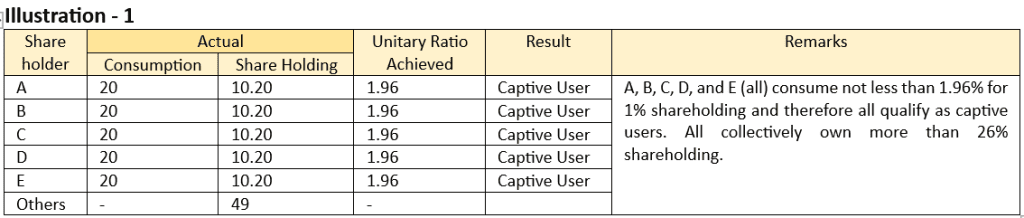
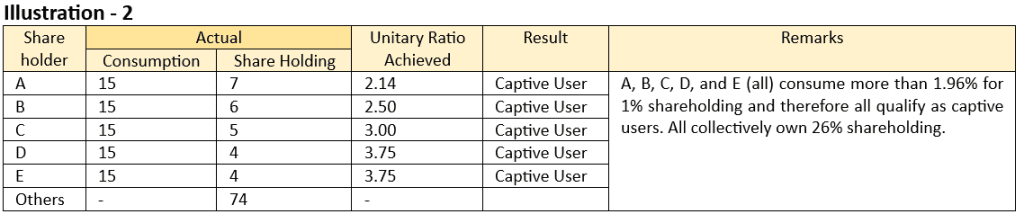
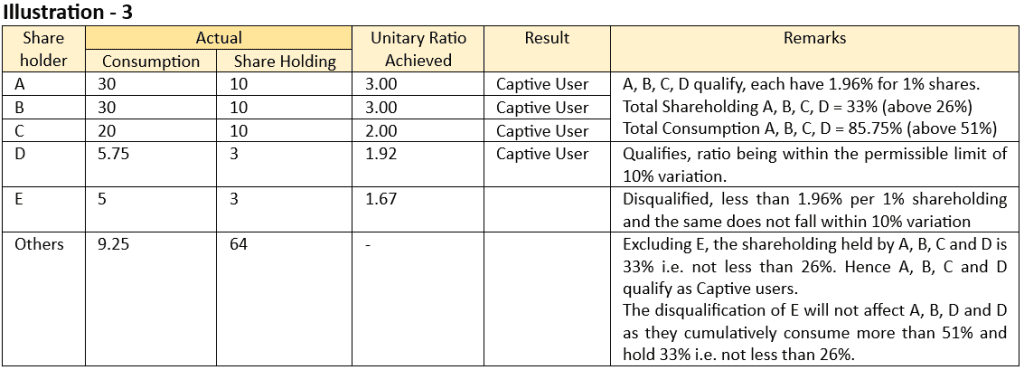
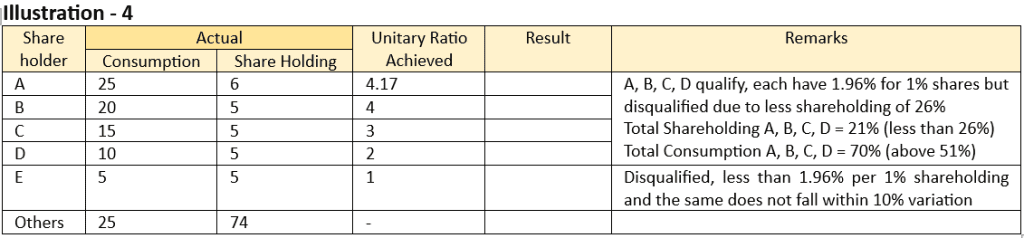
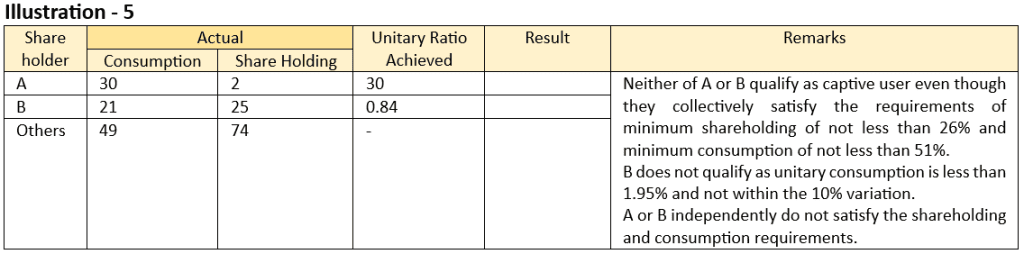
Once the above standard is met and satisfied, the person satisfying the requirement will be treated as a member of the group captive users. [DG-43]
9. Change of ownership, shareholding, or consumption of captive consumer
Section 9(2) the words used are “every person, who has constructed a captive generating plant and maintains and operates such plant”. The expression, “every person” can refer to a person who maintains and operates a CGP while not having constructed the CGP. It is not necessary that the person who maintains and operates the CGP must have also constructed the CGP. Construction, maintenance or operation can be by different persons.
A CGP does not lose its captive status due to transfer of its ownership or any part of its ownership, provided that the transferee, that is, a new captive user, complies with eligibility criteria specified under Rule 3 of the Rules. {DG-36]
In case of change of ownership, shareholding, or consumption, the principle of weighted average should be applied to ensure compliance of the proportional electricity consumption requirement stipulated under the second proviso to Rule 3(1)(a).
For instance, if a captive consumer exits or drops out in the middle of the year, transferring its shareholding to another or new captive user, it would be fair to hold that the captive user who has become a shareholder in the middle of the year, is required to consume proportionately to the electricity generated. In a given case, existing captive users taking advantage of the variation, may enhance their consumption. [DG-47]
The concept of weighted average shareholding comes in aid to calculate the relevant average shareholding of the captive user in the year and the proportionate electricity required to be consumed by him.
The weighted average shareholding method is applied by taking average shareholding held by particular shareholder for the year for the purpose of calculating proportionate electricity required to be consumed by it in terms of the second proviso of Rule 3(1)(a).
Illustration 1
A shareholder may hold shares in different percentage during the year in such case the percentage of its share holding during the financial year shall be calculated on weighted average basis: [CEA-6.3(ii) (a)]
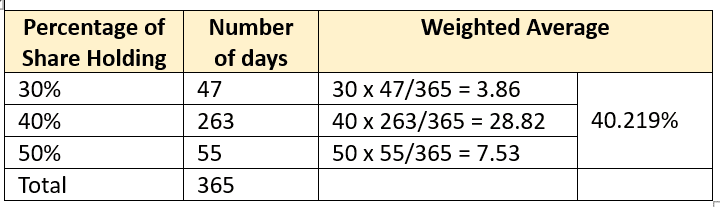
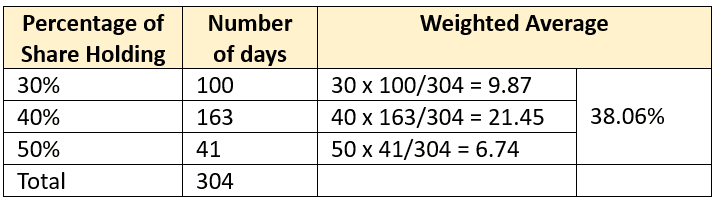
Illustration 2
For a newly commissioned plant during the year under consideration, the COD shall be starting date, e.g. 1st June of a Year. [CEA-6.3(ii)(b)]
10. Holding and Subsidiary Company as Captive consumer
Proviso to clause (b) to Explanation 1 to Rule 3 states that consumption by a subsidiary, or holding company as defined in the Companies Act, 2013, when one of them is a captive user, shall be also admissible as captive consumption by the captive user. Clause (b) to Explanation 1 to Rule 3 states that captive user is the end user of the electricity. Captive user is the actual consumer who uses electricity for his own use.
Sec 2(46) of Co Act 2003 defines “holding company”, in relation to one or more other companies, means a company of which such companies are subsidiary companies;
Sec 2(87) of Co Act 2003 defines “subsidiary company” or “subsidiary”, in relation to any other company (that is to say the holding company), means a company in which the holding company—
(i) controls the composition of the Board of Directors; or
(ii) exercises or controls more than one-half of the total voting power either at its own or together with one or more of its subsidiary companies
Illustration 1
The consumption of electricity by a subsidiary company of a Captive User shall also be admissible as consumption by the Captive User.
Explanation:
Assume company “A” holds requisite equity in CGP and company “B”, which is a subsidiary of company “A” and does not hold any direct equity in CGP. If the company “A” consumes, say 40% of the electricity generated by the CGP and company “B” consumes, say 12% of the electricity generated by the same plant. Then, the company “A” shall qualify as a Captive User, considering the total consumption of 52% (40%+12%). [CEA-6.5]
Illustration 2
The consumption of electricity by a holding company of a Captive User shall also be admissible as consumption by the Captive User.
Explanation:
Assume company “A” holds requisite equity in CGP and company “B”, which is a holding company of company “A” and does not hold any direct equity in CGP. If the company “A” consumes, say 40% of the electricity generated by the CGP and company “B” consumes, say 12% of the electricity generated by the same plant. Then, the company “A” shall qualify as a Captive User, considering the total consumption of 52% (40%+12%). [CEA-6.6]
11. Company set up as a SPV has multiple units generating electricity
Rule 3(1)(b) refers to a situation where a company set up as a SPV has multiple units generating electricity. It stipulates that the company formed as a SPV can identify one or more of such generating units for its captive use.
All the generating units need not be identified for captive use. The units which are not identified for captive use need not satisfy the conditions mentioned in paragraphs (i) and (ii) of Rule 3(1)(a) of the Rules. Electricity generated by these unidentified units need not be accounted and considered.
The explanation clarifies the situation as it states that the requirement of consumption of electricity by captive users shall be determined with reference to the generating unit or units identified for captive use. The unit or units identified for captive use, in other words, must satisfy the requirements of paragraphs (i) and (ii) of Rule 3(1)(a) of the Rules read with the second proviso. This is also clear from Rule 3(2), which states that the equity shares held by the captive user in the generating station, which is identified for captive use, should not be less than 26% of the proportionate equity of the company relating to the generating unit or units identified as a CGP.
Thus, Rule 3(1)(b) of the Rules liberalizes, gives flexibility and an option when a generating station owned by company, incorporated as a SPV, has multiple generating units. Rule 3(1)(b) does not undo or override the eligibility criteria specified under Rule 3(1)(a) read with second proviso.[DG-51]
Further, explanation 1(d) to Rule 3 of the Rules, defines a SPV to mean a legal entity owning, operating, and maintaining a generating station with no other business or activity to be engaged in by the legal entity. Thus, SPVs have a single purpose as envisaged under the Rules, that is, owning, operating and maintaining a generating station. A SPV cannot consume the electricity generated by the CGP by itself, that is, it cannot be a captive user since its only purpose is to own, operate and maintain a generating station. Thus, the purpose and objective of companies or body corporates in setting up an SPV, which cannot enjoy the benefits provided to captive users itself, would be for such body corporates, companies, or other persons to enjoy the common benefit of becoming captive users. [DG-57]
12. Applicability and exemption of charges
As per the Scheme of the Act, there can be two classes of consumers,
- the ordinary consumer or class of consumers who is supplied with electricity for his own use by a distribution licensee /licensee and;
- captive consumers, who are permitted to generate for their own use as per Section 9 of the Act, 2003.
- Consumers defined under Section 2(15) and the captive consumers are different and distinct and they form a separate class by themselves, since they as such are not to incur any expenditure and/or invest any amount at all. [MS-14]
- Sub-section (4) of Section 42 shall be applicable only in a case where the State Commission permits a consumer or class of consumers to receive supply of electricity from a person other than the distribution licensee of his area of supply and only such consumer shall be liable to pay additional surcharge on the charges of wheeling, as may be specified by the State Commission. Captive user requires no such permission, as he has statutory right. [MS-9]
- There is a logic behind the levy of additional surcharge on the charges of wheeling in such a situation and/or eventuality, because the distribution licensee has already incurred the expenditure, entered into purchase agreements and has invested the money for supply of electricity to the consumers or class of consumers of the area of his supply for which the distribution license is issued. Therefore, if a consumer or class of consumers want to receive the supply of electricity from a person other than the distribution licensee of his area of supply, he has to compensate for the fixed cost and expenses of such distribution licensee arising out of his obligation to supply. Therefore, the levy of additional surcharge under sub-section (4) of Section 42 can be said to be justified and can be imposed and also can be said to be compensatory in nature. [MS-13]
- In the case of the captive consumers/captive users, they have also to incur the expenditure and/or invest the money for constructing, maintaining or operating a captive generating plant and dedicated transmission lines. Therefore, so far as the captive consumers / captive users are concerned, they are not liable to pay the additional surcharge under Section 42(4) of the Act, 2003. [MS-13]
- A captive generating plant is entitled for certain benefits under the Act which are not admissible to other generators. Fourth proviso of Section 42 (2) provides that “such surcharge and cross subsidies shall not be leviable in case open access is provided to a person was established a captive generating plant for carrying the electricity to the destination of his own use.” [DG-]
- Proviso to Sec 38, 39, 40, 42 of EA 2003, prohibits levy of surcharge, cross or additional surcharge, even when open access is provided to a person who has established a CGP for carrying the electricity to the destination of their own use.
13. Important Judgements answering the various questions raised therein on Captive Power
- Kadodara Power Pvt. Ltd. & Others vs Gujrat Electricity Regulatory Commission & Others
“Can the ownership of the CGP be transferred after its set up?”
- It is submitted that the words “set up” here are important and that the person who has set up the plant alone can own captive generating plant and not the person(s) who is transferee from the original owner(s).
- The Act nowhere prescribes that once set up by a person(s) a captive generating plant cannot be transferred to another owner. Nor does the Act say that on transfer of ownership the captive generating plant will lose its character of being captive despite fulfillment of all other conditions requiring it to be so.
- Section 9 of the Act which permits captive generation begins with the following words: notwithstanding anything contained in this Act, the person may construct, maintain or operate a captive generating plant and dedicated transmission lines”.
- Obviously, the owner of a captive generating plant need not be one who constructs. Set up defined in section 2(8) has been made equal to “construct, maintain or operate” by the use of these words in section 9.
- As we view it a captive generating plant does not lose its character by transfer of the ownership or any part of the ownership provided the generating plant produces power primarily for the use of its owner(s). The Regulation quoted above lays down further restrictions on the user of the power generated by a CGP.
- If all the provisions of the Act and Regulations governing captive generation and consumption from the CGP are specified a plant will be a CGP notwithstanding the fact that the plant at present is not owned by the person who originally set up the plant.” [KP-21]
- Hon’ble Supreme Court agreed with the said interpretation and logic. A CGP does not lose its captive status due to transfer of its ownership or any part of its ownership, provided that the transferee, that is, a new captive user, complies with eligibility criteria specified under Rule 3 of the Rules. [MG-36]
“How proportionality of consumption has to be assessed:”
- The Electricity Rules 2005 have set down that not less than 51% of the aggregate electricity generated by a CGP, determined on an annual basis is consumed for captive use. However, in case there are more than one owner then there is a further rule of proportionality in consumption.
- In case the power plant is set up by a cooperative society the condition of use of 51% can be satisfied collectively by the members of the cooperative society. However, if it is an ‘association of persons’ then the captive users are required to hold not less than 26% of the ownership of the plant and such captive users are required to consume not less than 51% of electricity generated determined on an annual basis in proportion to the share of the ownership of the power plant within a variation not exceeding + 10%.
- For example, if a CGP produces 10,000 kWh of electricity, 5100 kWh need to be consumed by the owners of CGP. In case there are three owners holding equal share, each one must consume 1/3rd of the 5100 kWh within a variation of + 10% i.e. between 1530 kWh to 1870 kWh.
- It will not be proper to assess the proportionality of the consumption on 100% of the generation. The 51% of total generation only has to satisfy the rule of proportionality in consumption and ownership. The rest 49% of the generation could be sold to anyone including grid, Distribution Company and the CGP owners themselves. Further such calculation has to be done on an annual basis i.e. for a financial year.” [KP-17]
- Hon’ble Supreme Court agreed with the view of APTEL. [DG-42]
- Maharashtra State Electricity Distribution Co. Ltd. vs M/s. JSW Steel Limited & Ors.
“Whether the captive consumers/captive users are liable to pay the additional surcharge leviable under section 42(4) of the Electricity Act, 2023”
Held, that such captive consumers/captive users, who form a separate class other than the consumers defined under Section 2(15) of the Act, 2003, shall not be subjected to and/or liable to pay additional surcharge leviable under Section 42(4) of the Act, 2003.
- Chhattisgarh State Power Distribution Company Limited v. Chhattisgarh State Electricity Regulatory Commission and Anr. [CIVIL APPEAL NOS. 2578-2579 OF 2008] Order dated 12.05.2022
“Whether the open access for transmitting electricity from SBPIL to SBMPL would be for own use or not”
- Here, Shri Bajrang Power and Ispat Ltd (SBPIL) has established a Captive Power Generation plant (CGP) sought permission from Chhattisgarh State Electricity Regulatory Commission (CSERC) for providing open access and wheeling power through transmission system of the Chhattisgarh State Power Distribution Company Limited (CSPWCL) for captive use by Shri Bajrang Metallics and Power Ltd (SBMPL), sister concern of SBPIL.
- Captive generation at SBPIL 103.68 MU per annum, 13.22 MU p.a. (14.16%) shall be utilised by SBPIL, 54 MU (57.87%) supplied to SBMPL and balance sold to CSPWCL.
- SBMPL holds 27.60% equity shares of SBPIL and SBPIL holds 72% shares of SBPIL.
- Admittedly, SBMPL holds 27.6% equity shares in SBPIL. As such, the requirement of not less than 26% of shares is fulfilled by SBMPL, the joint consumption by SBIPL and SBMPL is more than 51%. As such, both the conditions as provided under Rule 3 of the said Rules are satisfied.
- Upheld, the order passed by CSERC and maintained by APTEL that SBPIL was entitled to supply electricity to its sister concern SBMPL and the same would qualify to be treated as ‘own consumption” within the ambit of Section 9 read with Section 2(8) EA 2003 and Rule 3 ER 2005.
- M/s Dakshin Gujarat Vij Company Limited vs M/s Gayatri Shakti Paper and Board Limited and Another, etc
Three issues arise for specific consideration in view of the conflicting judgments of the APTEL.
- Eligibility criteria for a CGP/captive user under Rule 3(1)(a) of the Rules
- Interpretation of the second proviso under Rule 3(1)(a) of the Rules and in particular the words “association of persons”.
- Whether a company set up as a Special Purpose Vehicle for generating electricity is an, “association of persons”, in terms of the second proviso to Rule 3(1)(a) of the Rules.
The above-mentioned issues have been discussed above in respective headings
Bibliography
- Electricity Act 2003 as amended,
- Electricity Rules 2025 as amended,
- Naitonal Electricity Policy 2005,
- Central Electricity Regulatory Authority, Order 10/2025 dated 10.02.2025, {Referred as CEA}
- Kadodara Power Pvt. Ltd. & Others vs Gujrat Electricity Regulatory Commission & Others [A. No. 171 of 2008, A. No. 172 of 2008 & IA Nos. 233/08 and 234/08, A. No. 10 of 2008 and A. No. 117 of 2009] Order dated 22.09.2009
- Maharashtra State Electricity Distribution Co. Ltd. vs M/s. JSW Steel Limited & Ors. [CIVIL APPEAL NOS. 5074-5075 OF 2019] Order dated 10.12.2021 {Referred as KS}
- Chhattisgarh State Power Distribution Company Limited v. Chhattisgarh State Electricity Regulatory Commission and Anr. {Referred as CS}
- M/s Dakshin Gujarat Vij Company Limited vs M/s Gayatri Shakti Paper and Board Limited and Another, etc. [Civil Appeal nos. 8527-8529 OF 2009] Order dated 09.10.2023 {Referred as DG}
Categories:
Get Subscribe To Our Latest News & Updates
Stay updated with our latest insights.